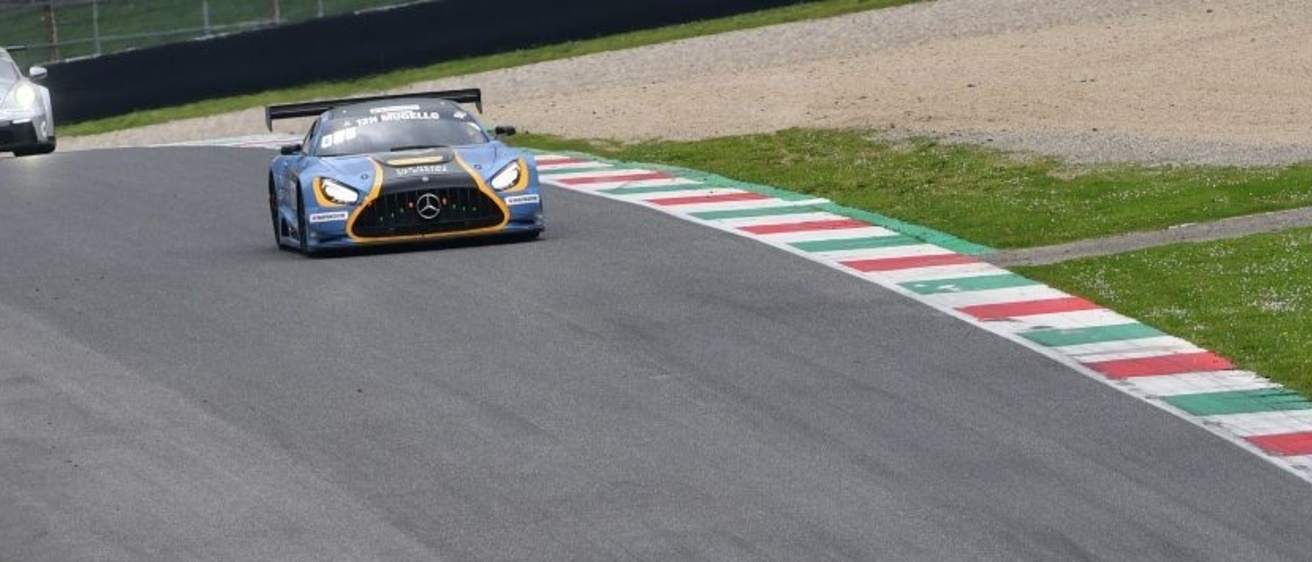
When audiences watch F1: The Movie, they’re seeing more than fast cars and a high-tech driving simulator. They’re witnessing the power of University of Iowa innovation: The vehicle dynamics research used in motion-based driving simulators around the world has roots at the University of Iowa.

The F1 movie team sought realism — not just CGI — and turned to real-world tools like high-fidelity driving simulators. Engineers and filmmakers used the results of decades of vehicle dynamics research to refine the feel, physics, and dynamics of the F1 car as portrayed on the big screen.
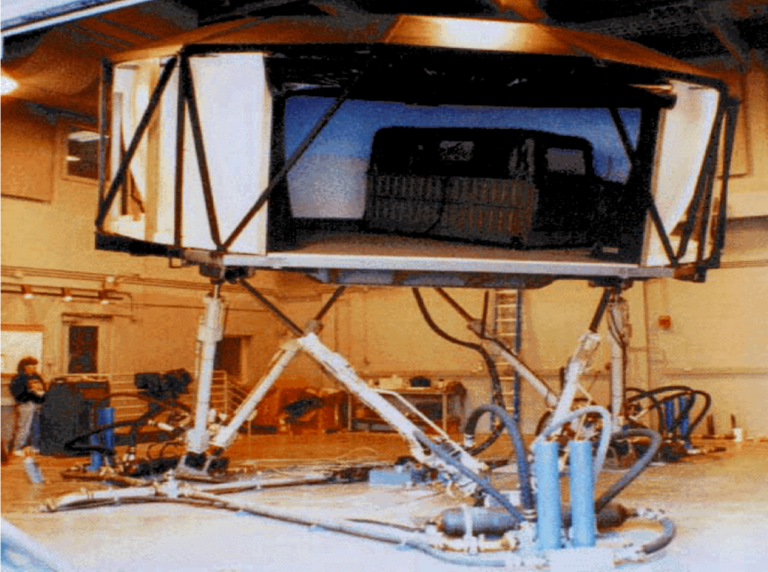
While most people associate racing tech with Germany, Italy, or Silicon Valley, Iowa has been home to not one, but two of the world’s most sophisticated driving simulators: first the Iowa Driving Simulator built in 1989; then the National Advanced Driving Simulator (NADS-1) in 2001 — still one of the most advanced motion-based driving simulators in the world.
But the story starts earlier.
The birthplace of vehicle dynamics
In the 1980s and 1990s, engineers and students at the UI’s Center for Computer-Aided Design led by Ed Haug, professor emeritus of mechanical engineering, laid the foundation for modern ground-vehicle dynamics research and made significant progress toward developing tools for the virtual evaluation of vehicle design.
They extended previous work in multi-body dynamics and, in collaboration with others, developed tools for the forces acting on a vehicle traversing uneven terrain, and also for evaluating fatigue life and durability of components within the vehicle based on the calculated load history.
These systems linked mathematical models to calculate the forces on and the motion of moving parts —mass, tires, engine power, suspension, terrain interaction, and internal cabin forces on the driver.
Collaborating with other universities, Haug’s team created software that transformed these dynamics into code for realistic simulation models.
“We were the place where many of those ideas on virtual product design came to fruition and were engaged in this work well ahead of others in the field,” said Andrew Veit, miniSim director.
This work led to the development of the Dynamic Analysis and Design System (DADS), which was used for many years by the U.S. Army in prototyping of military vehicles and commercialized by CAD Systems Incorporated, which is now part of Siemens’ PLM product Simcenter.
After DADS, Haug’s team developed the IDSDyna software, used to power the original Iowa Driving Simulator, one of the first motion-base driving simulators in the U.S.
The Iowa team’s innovations in simulation enabled engineers to simulate ground-vehicle stress responses before building physical prototypes. This included terrain modeling, load calculations, durability predictions, and tire modeling — one of the most complex aspects of vehicle dynamics. These advances led to the concept of the “virtual proving ground,” where engineers could test and refine designs entirely in simulation, changing how vehicle manufacturers designed vehicles.
By the 1990s, the University of Iowa had become a reference point for high-fidelity driving simulation. Their research extended into early studies on anti-lock braking systems, intra-ocular lens implants, airplane controls, and some of the world’s first automated driving simulations.
The creation of NADS-1
The university’s expertise in vehicle dynamics research was a key reason NHTSA selected Iowa to host the National Advanced Driving Simulator.
Early research on the NADS-1 included tire failure and loss of control, electronic stability control, hard braking maneuvers, driver distraction from early wireless phones, and agricultural applications with John Deere.
The IDSDyna software evolved into NADSDyna, which now powers both the NADS-1 simulator and DSRI’s miniSimTM — custom driving simulators sold to research teams worldwide.
A reference point in driving simulation
The NADS-1 simulator still features one of the world’s largest motion bases. Its dome-on-rails architecture allows for extensive lateral and longitudinal movement, surpassing the capabilities of most dome-on-sled systems. This design became a benchmark for motion fidelity (i.e., realism), attracting companies like Toyota and McLaren Racing to Iowa to test its motion capabilities and refine their own simulators.
Chris Schwarz, director of engineering and modeling research at DSRI, recalled a visit from McLaren Cars, a high-end sports car maker and F1 racing team visit: “They brought their vehicle dynamics software, and we put an F1 course into our system. Their drivers gave feedback on how it felt. That helped them tune their own simulator specification.” MTS Systems Corporation, which built the NADS-1, also constructed the Vehicle Dynamics Simulator (VDS) for McLaren.
A lasting legacy
Although vehicle dynamics is no longer an active research focus at Iowa, its legacy lives on through human factors research in driving safety. The NADS-1 remains the crown jewel of the facility, supporting research on drowsy and distracted driving, drugged driving, and connected and automated vehicles, among other topics.
F1: The Movie shows driving simulation technology rooted in Iowa’s pioneering work. While the simulator in the movie doesn’t use the same software, the principles behind it — accurate vehicle dynamics modeling, realistic motion systems, and human-in-the-loop testing — trace back to Iowa’s groundbreaking research. And it’s one example of how research investments ripple outward — influencing policy, industry, and even pop culture.
Daniel McGehee, DSRI director, reflected on the institution’s enduring impact: “The University of Iowa has been a pioneer in developing and testing advanced vehicle systems for decades, so seeing movies like F1: The Movie highlight the very technology we helped create is deeply gratifying,” McGehee said. “It’s a reminder that some of the most influential automotive research in the world began right here at the University of Iowa.”
So the next time you hear an F1 engine roar, know that part of that thrill was born right here in Iowa.
Related: History of Driving Research at the University of Iowa